

The choice affects more than conversion rate
We see businesses constantly debate the merits of whatsapp ads vs lead forms. The reality is that your chosen destination directly impacts your lead quality, your daily workload, and your ability to forecast revenue.
Our WhatsApp Lead Generation framework prioritizes chat by default, using forms only when specific data fields are absolutely required. This choice is a major operational decision posing as a simple marketing tactic.
Recent 2026 figures show WhatsApp penetration sits at nearly 98 percent among Ghanaian smartphone users, meaning chat feels entirely natural to your buyers. We are going to break down chat vs form conversion rates, compare the real-world tradeoffs, and show you exactly how to capture the most valuable leads.
Let’s look at the data.
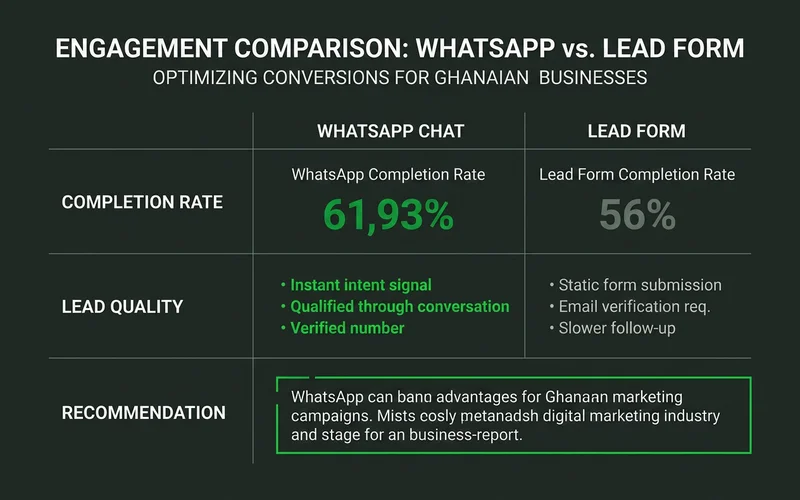
Completion rate on Ghanaian mobile data
Our experience shows that chat completion rates easily outperform web forms on local mobile networks. The friction difference in Ghana is massive because a single dropped connection on a form costs you the entire lead.
We know that asking someone to load a heavy landing page over 3G or spotty 4G often leads to silent drop-offs. Ghana reached 28.7 million mobile data subscriptions by early 2026, but network speeds still fluctuate widely depending on the neighborhood.
Common points of failure for traditional web forms include:
- Slow page load times on mid-range phones.
- Frustrating typing experiences on small touchscreens.
- Lack of immediate confirmation after tapping submit.
A WhatsApp message removes this risk completely. The app is likely already open on their phone, and the delivery ticks provide instant visual confirmation.
We notice that users feel confident because they know their message actually arrived. Meta lead forms offer a helpful middle ground by opening inside the Facebook or Instagram app.
They pre-fill the customer’s known details, removing typing friction while preserving structured data.
The lead quality trade-off
We always warn clients that higher enquiry volume does not automatically translate to more revenue. Chat brings in a flood of casual questions, while the friction of a form naturally filters out buyers who are not yet serious. The low barrier of WhatsApp means you will spend time answering casual price checks from passing homeowners and dealing with people outside your service area.
Our team regularly sees WhatsApp click-through rates hitting 45 to 60 percent, which is fantastic for engagement but terrible if your sales staff lacks filtering tools. Forms ask prospects to invest genuine effort.
Someone who completes six mandatory fields is usually further along in their buying decision. To determine the best enquiry channel ghana has to offer for your business, you have to identify your current operational bottleneck.
| Feature | WhatsApp Chat | Traditional Lead Form |
|---|---|---|
| Completion rate | Extremely high (often 45-60% CTR) | Significantly lower |
| Lead qualification | Mixed, requires manual filtering | Higher on average |
| Data structure | Unstructured text thread | Clean, organized fields |
| CRM integration | Requires specific API tools (e.g., Zoho) | Direct and immediate |
| Follow-up | Same thread with 98% open rates | Call or email (around 20% open rate) |
| Works outside hours | Yes, via automated away messages | Yes, collects data 24/7 |
| Attribution | Exact, via referral payload | Exact, via form source |
We recommend prioritizing chat if you desperately need more volume. If your staff is overwhelmed with useless messages, you need to use forms or add qualifying questions to your automated chat greetings.
Follow-up burden
We find that chat decisively wins the follow-up game because it keeps the conversation in a single, active thread. Attempting to follow up on a web form means relying on phone calls that go unanswered or emails that get lost.
Following up a form submission forces you to call an unknown number.
Our clients report that many customers simply ignore calls from numbers they do not recognize. Sending an email is equally frustrating, as standard marketing emails hover around a 20 percent open rate.
The advantages of chat-based follow-up include:
- Instant delivery and read notifications.
- A complete, scrolling history of past interactions.
- The ability to send images, voice notes, and PDF brochures instantly.
We love that replying to a chat adds a message to an already open thread. Both sides can see the full history, and 2026 data shows WhatsApp open rates consistently remain at roughly 98 percent.
For real estate agencies serving homeowners, local clinics, or any business requiring multiple exchanges, this continuity is far more valuable than the initial completion rate. The follow-up load is also what most owners underestimate, which is why we usually pair the channel with an automated WhatsApp enquiry flow that qualifies before a human picks up.
CRM and record-keeping
Our biggest argument in favor of forms is the ability to automatically sync clean data into your customer database. When comparing a lead form vs whatsapp for data entry, structured fields flow directly into systems like HubSpot or Zoho without requiring manual work. Every single record maintains the exact same shape.
We rely on this consistency to generate accurate reports and forecast sales. When you use chat, you are dealing with unstructured text transcripts that require human interpretation. Someone on your team has to read every conversation and manually copy the details into the system.
Our integration specialists note that syncing WhatsApp requires the official Business API, which introduces per-conversation costs under Meta’s 2026 pricing model. For a business seriously tracking a pipeline, manual entry is a massive ongoing expense.
The practical middle ground
Automate two qualifying questions in the WhatsApp greeting, specifically asking for the desired service and the customer’s location. This ensures every conversation starts with the exact two fields you would have collected in a web form anyway. It recovers most of the necessary structure without introducing annoying friction.
When to run both
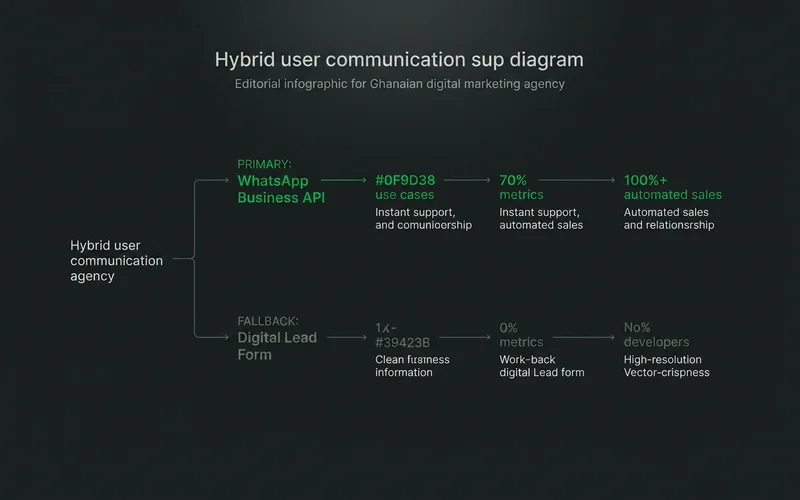
We strongly advise any business handling meaningful enquiry volume to run both channels simultaneously. You should position WhatsApp as the primary, highly visible path because it simply converts at a higher rate.
A traditional form serves perfectly as a secondary option.
Our data indicates that some customers prefer not to share their phone numbers immediately. Others might be browsing at 11 PM and would rather leave their details than initiate a live conversation.
The best practices for a hybrid setup include:
- Placing a floating WhatsApp button in the bottom corner of every page.
- Using a short, simple form on the dedicated contact page.
- Clearly stating your expected response times for both channels.
The most common mistake is making both options equally prominent on your page. We see this force customers to make a confusing choice they do not want to make. You must design your site with one obvious primary path and one clearly visible alternative.
If your website form is currently your only path and it is underperforming, the root cause might actually be the page layout rather than the format itself. Our comprehensive guide explaining why Ghanaian websites fail to convert paid traffic covers the exact diagnostic steps to fix this.
Take a hard look at your current setup today, choose a primary channel based on your team’s capacity, and start testing the difference.