

Why this matters now, not later
You have probably noticed how search habits are shifting across Ghana and beyond. Many users now skip standard results entirely and ask AI tools for direct recommendations.
This change is fundamentally altering how local businesses get discovered online.
For a local business, building an ai search optimization website matters immediately because massive volumes of traffic are bypassing traditional search engines. In fact, platforms like Perplexity AI are processing over 1.2 billion queries a month as of mid-2026.
- People are actively asking, “Who does local SEO in Kumasi?” and expecting instant answers.
- Users search for “Best dental clinic in East Legon?” directly in chat interfaces.
- Questions like “How much does a website cost in Ghana?” are answered without opening Google.
We see AI assistants cite a handful of sources, and the businesses named in that answer get the actual consideration. If your site is machine-legible, you become a prime candidate for that direct citation. A slow template with no structured data leaves you completely out of the conversation.
This is a massive differentiator in the Ghanaian market right now. Almost nobody is building their digital presence for this specific requirement.
Every Website Design build we ship includes the exact technical layer described below. Let us look at the data, what it actually means for your visibility, and explore the practical steps to respond.
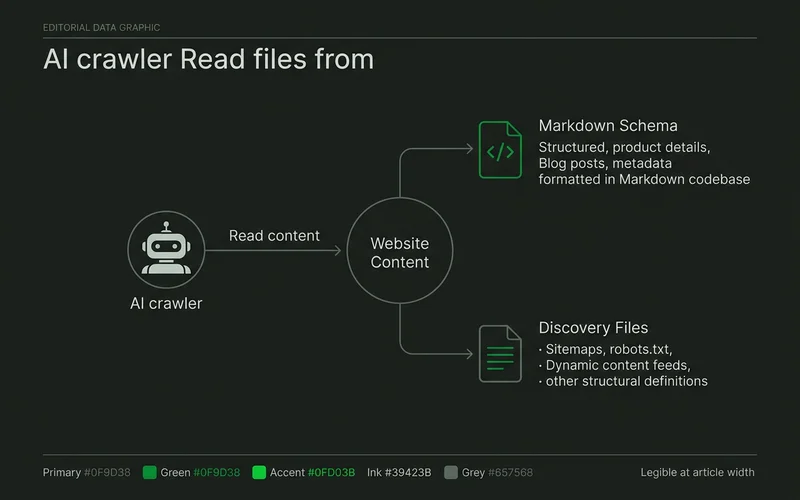
How LLM crawlers read differently from Googlebot
LLM crawlers read raw HTML and markdown to extract concrete facts, unlike traditional bots that render complex visual layouts. They are building an immediate answer for the user, not just cataloging a vast index of links. Googlebot has spent two decades learning to interpret messy human web pages, using enormous context to infer structure from visual hierarchy.
AI agents are far less forgiving and differently motivated. They want text they can parse quickly, facts they can extract cleanly, and a structure they can trust implicitly.
The Shift from Rendering to Parsing
A 2026 industry analysis of over 330,000 pages highlighted that content relying heavily on client-side JavaScript often gets skipped entirely by AI crawlers. These models need to fetch and chunk data in real-time. Content must exist in the raw HTML rather than being assembled by scripts after the page loads.
Practically, this makes fast server-side rendering far more critical than it is for traditional SEO. Slow pages that require heavy processing will simply time out when an AI assistant is trying to formulate a quick response.
Explicit statements are absolutely necessary because implied meanings get lost during the data extraction process. We advise clients to state their core facts clearly and directly. Stating “We provide local SEO services in Kumasi and Accra from 4,000 GHS per month” gives the model exact data to serve a user. A massive hero image with the word “Growth” plastered across it offers an AI model zero usable context.
Clean heading hierarchy that maps to actual content structure is also essential for these models. Finally, factual consistency across your pages ensures trust; contradictions reduce the confidence a model has in your data, causing it to skip citing you entirely.
The four components of an AI-ready site
An ai agent ready site requires comprehensive structured data, plain-text LLM summaries, markdown page versions, and explicit crawler discovery files. These four specific elements give language models exactly what they need to understand and cite your business accurately.
Our standard deployment process treats each of these components as mandatory for modern visibility. The goal is to remove any guesswork for the AI agent scanning your pages.
- Structured data, comprehensively. Do not stop at a basic LocalBusiness tag. You need Service schema for each offering, FAQPage for question content, Person for named team members, Offer for exact pricing, GeoCircle for service areas, and BreadcrumbList for hierarchy. We ship more than 20 types across a standard build. Each one states a fact in a format that software reads without needing to infer anything.
- LLM summaries and llms.txt files. A plain-text or markdown summary of the business acts as a direct brief for AI. In 2026, implementing an
llms.txtfile at your root domain has become a standard way to tell AI agents exactly what your business does, where you operate, and your credentials. This file gives friendly bots a fast track to your most important information. - Markdown page versions. Clean text versions of key pages, stripped of navigation, heavy styling, and scripts, are incredibly helpful. A model reading the markdown version of your service page gets the core message without wading through complex visual layout code.
- Discovery files and crawler signals. These files tell AI agents what exists on the site and where to find it. If you want to know how to make chatgpt cite my website, the solution starts with a clean
robots.txtpolicy that explicitly allows the AI user agents you want reading your site. This includes specific calls for GPTBot, ClaudeBot, PerplexityBot, OAI-SearchBot (which handles real-time ChatGPT search citations), and Google-Extended.
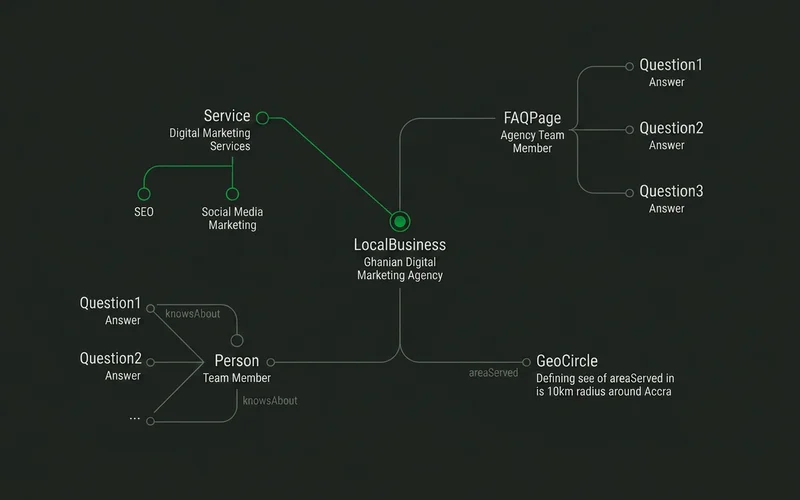
The schema that makes a business machine-readable
Schema markup is the standardized code that translates your local business details into a format AI can instantly verify. It confirms hard facts like your exact physical location, service offerings, and pricing tiers so a model can confidently recommend you.
Industry data shows that over 72% of top-ranking standard search pages utilize schema markup. For AI search optimization, providing this structured data is absolutely mandatory.
| Schema type | What it states | Why an AI needs it |
|---|---|---|
| LocalBusiness | Identity, address, hours, contact | Confirms you are a real, locatable entity |
| Service | Each offering, described | Lets a model match a query to a specific service |
| Offer | Price and currency | Answers cost questions without inference |
| FAQPage | Question and answer pairs | Directly extractable answers |
| Person | Named people and credentials | Supports expertise and trust assessment |
| GeoCircle | Service radius | Answers “do they cover my area” |
| BreadcrumbList | Site hierarchy | Clarifies how content relates |
The pattern across all of these properties is simple. You must state facts explicitly rather than leaving them to be inferred from long paragraphs of prose. A model that has to guess your pricing for a website build in Accra will usually decline to state one.
You lose the citation on every single cost-related question as a result. We always run sites through the Schema.org Validator before launch. This ensures every piece of code is perfectly formatted for AI extraction.
The most common gap we find
Businesses with good content and no structured data. Everything a model needs is on the page in prose, and none of it is in a form the model can extract with confidence. Adding schema to existing good content is one of the cheapest wins available.
Robots policy for AI crawlers
Your robots policy dictates exactly which AI agents are permitted to read and cite your website content. You must make this decision deliberately, as default firewall settings often block the very bots you want citing your local business.
Blocking AI training bots protects your content from being used to train large models. That choice also completely removes you from the pool of businesses those models can recommend to local users. For a service business in Ghana seeking visibility, that trade rarely makes financial sense.
You want to be cited as a top provider, and being cited requires being read by the machine.
- Avoiding Accidental WAF Blocks: Many businesses are invisible to AI without even realizing it. Recent 2026 security data revealed that Web Application Firewalls, like Cloudflare’s default settings, frequently block AI crawlers accidentally.
- The Data: Websites actively blocked bots like GPTBot nearly seven times as often as traditional search crawlers over the last year.
- The Fix: You need specific lines for bots that provide real-time answers, like
OAI-SearchBotfor ChatGPT search features andPerplexityBot.
Our team defaults to explicitly allowing all major AI search and training bots by name in the robots.txt file, alongside a general allow rule. The businesses that should think harder about strict blocking policies are publishers whose written content is their actual product.
A local dental clinic, a Kumasi restaurant, or an Accra design agency is not in that position. Your product is the service you provide, and the AI is simply the referral engine.
How this connects to traditional SEO
Making a site readable for AI directly improves your traditional SEO performance because both systems reward clear structure and fast loading times. Treating llm seo as a completely separate discipline often leads to unnecessary technical gimmicks.
Everything that makes a site AI-readable also makes it significantly better for standard Google search. Clear architecture, real and accurate content, explicitly stated facts, lightning-fast loading, and perfectly working markup benefit every type of visitor.
Modern SEO plugins like Rank Math already rely heavily on this same structured data to secure standard rich snippets. The additional AI layer includes markdown versions, discovery files, and explicit LLM summaries.
This specific layer is genuinely extra work, but it sits firmly on top of good technical fundamentals rather than replacing them. If those basic fundamentals are not currently in place, you must start there.
Our Local SEO programme covers the essential foundations required to rank in Ghanaian search results. The advanced AI layer then ships directly with the website build inside that very same package, at no premium over the figures in our guide to what website design costs in Ghana.
Your Next Steps for AI Visibility:
- Audit your current structured data using the Schema.org Validator.
- Verify your
robots.txtfile is not accidentally blocking major AI bots. - Create an
llms.txtfile to summarize your core offerings.
Review your site architecture this week to ensure AI agents can actually read your facts.
Contact us if you need help implementing these critical machine-readable layers.