

The question is structure, not size for a small business website vs corporate website
“Small business” and “corporate” sound like company-size labels, but they actually describe structural complexity. When comparing a small business website vs corporate website, plenty of large Ghanaian businesses genuinely need a small site, while some three-person operations require a much larger one.
As a professional service team, we focus on how many distinct audiences your site serves and how many decisions each visitor needs to make.
This distinction shapes the entire project.
Local tech adoption in 2026 demands clarity over sheer volume, especially with Ghana’s internet penetration passing 70%. Our Website Design builds the architecture from that audience structure rather than from your employee headcount. The result is a digital presence that actually converts visitors into clients.
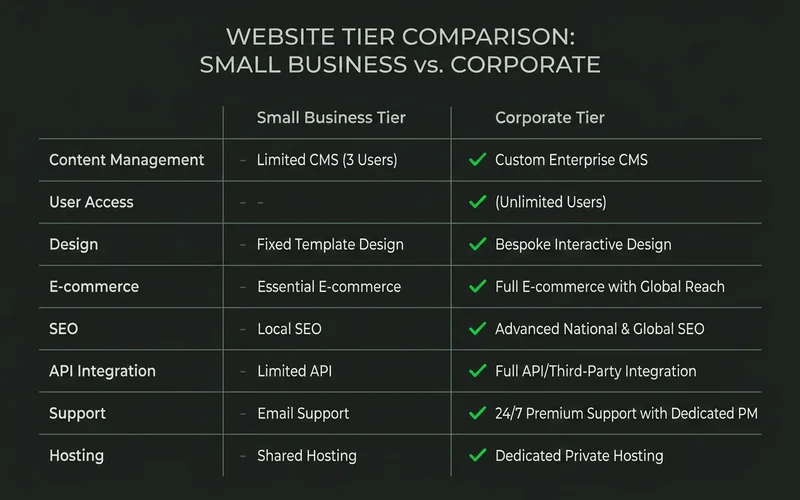
What each tier actually contains
A small business site typically contains 5 to 10 pages covering core services, while a corporate build requires 20 or more pages to handle multiple departments, compliance, and varied audiences. Understanding your correct website tier in Ghana is about functional depth rather than prestige. We use this breakdown to help clients categorize their immediate technical needs.
| Small business site | Corporate site | |
|---|---|---|
| Typical pages | 5-10 | 20+ |
| Audiences served | One or two | Several, often internal and external |
| Service depth | One page per service | Clusters per service line |
| Locations | One, or a single areas page | A page per branch |
| People | Short about section | Team, leadership, careers |
| Compliance content | Privacy, terms | Plus policies, certifications, investor material |
| Content maintenance | Occasional | Ongoing, often multiple contributors |
Data from recent local SEO studies in 2026 shows that an average local service business only needs around 5 to 10 foundational pages to rank well initially. A small business site simply answers what you do, if it fits the user’s needs, if they can trust you, and how to contact you.
We often see companies waste money on filler content when these core answers are missing. Four questions handled well on a handful of pages provide massive value. A corporate site answers those basics plus complex inquiries like departmental routing, procurement standards, and hiring status.
When five to eight pages is genuinely enough
Five to eight well-structured pages are entirely sufficient when you have one location, a few core services, and a single target customer profile. People constantly ask how many pages a website needs to perform well. We consistently see that a well-built eight-page site generates better local search visibility than a twenty-five-page site filled with fluff.
The extra pages in larger versions usually end up being thin content, which dilutes topical focus and confuses visitors. Search engines penalize this lack of depth. Our team approaches page count as a multiplication problem of services and locations, not an arbitrary quota.
The common mistake is confusing page count with actual substance. A single service page detailing costs, processes, and common questions beats four short pages covering the same ground in fragments. You must consolidate related information to keep the reader engaged.
Where a small site does need to grow is when a service has enough depth of buyer questions to justify its own content cluster. We build these clusters to cover cost comparisons, common concerns, and detailed expectations. That is not an inherently corporate feature, as it applies at any scale to improve authority.
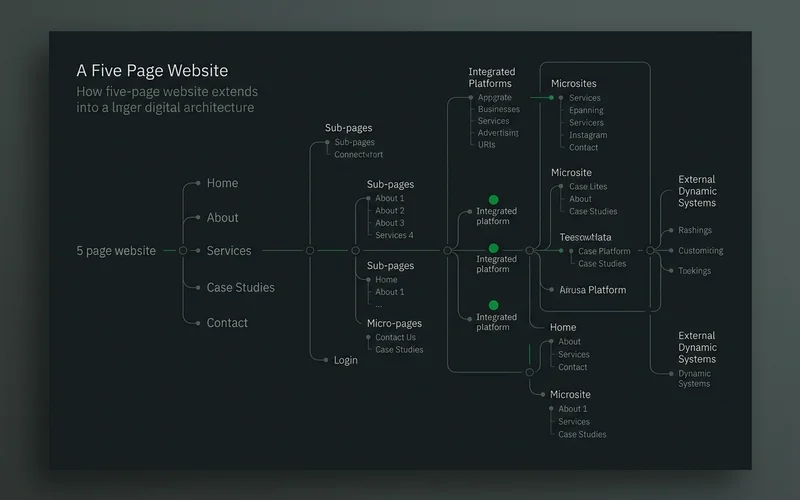
What corporate builds actually add
Corporate builds add structural complexity, including multi-department routing, compliance governance, deep CRM integrations, and advanced content management systems. These corporate website features transform a basic brochure into an operational tool. We engineer these systems to handle heavy traffic and complex user journeys.
Here is what pushes a project into the corporate tier:
- Multi-department structure: Different divisions require their own entry points and unique content depth.
- Careers functionality: A real jobs portal includes dynamic listings and an application path, functioning as a standalone web application.
- Compliance and governance: Procurement teams often shortlist vendors based on easily accessible policies, certifications, and investor materials.
- Multiple locations: A dedicated page per branch provides specific addresses, hours, maps, and local schema markup.
- Multi-contributor management: Roles and review workflows are necessary when several authors publish content inconsistently.
- Deeper integrations: Corporate sites connect directly to tools like HubSpot CRM, ERP platforms, or secure payment gateways.
We regularly integrate local payment solutions like Hubtel or Paystack to handle high-volume enterprise transactions. For context, one major pan-African gaming company recently processed over GHS 162 billion through Hubtel’s infrastructure in Ghana. Your business might not process billions, but the technical requirement for secure data handoffs remains the same.
The tell that you need the bigger build
You keep saying “it depends which department” when describing what your business does. That sentence means your audiences are genuinely different, and one page cannot serve them.
Cost implications
Adding custom integrations like payment gateways and booking systems increases costs far more than simply adding new text pages. Page count moves the budget less than most people expect, while backend engineering moves it the most. We explain this distinction to help clients allocate their marketing funds effectively.
A ten-page site and a twenty-page site with identical functionality differ mainly in content production time. The math changes completely when you introduce complex data handling. Our pricing structures account for these technical differences from day one.
Here is how different technical requirements impact your budget:
- Content-heavy builds: Adding ten basic text pages only requires copywriting and layout time.
- Integration-heavy builds: Adding a direct Paystack integration or a CRM sync requires custom engineering and strict security testing.
- Packaged solutions: Inside the Local Growth Package, the localized build is included at no extra cost to cover the small-business tier comfortably.
Corporate-scale builds and complex software connections are scoped separately based on technical requirements. Our website design cost guide sets out the GHS bands and clarifies exactly what pushes a project between them.
Starting small without painting yourself in
When evaluating a small business website vs corporate website, the most critical factor is whether your chosen architecture can expand later without a complete rebuild. Starting small is a smart financial move if the foundation is flexible. We prioritize scalable structures that adapt to your business growth over time.
Using an adaptable system, such as a properly configured headless CMS or an extensible WordPress environment, prevents future bottlenecks. Our architectures are designed to extend organically as your needs change. Adding new service pages, detailed location hubs, or a dedicated careers section later does not require tearing the site down.
The URL structure, navigation logic, and underlying content model were deliberately built to accommodate these additions smoothly. What causes expensive headaches is starting on a rigid template that assumes a fixed shape forever.
The golden rule of website scaling
If you are choosing between a cheap, inflexible build now and a slightly larger extensible one, the second option is usually cheaper across a three-year timeline.
We strongly advise taking the long view to protect your digital investment. Reach out to our team today to discuss an architecture that fits your current size and future goals.