

The cost per lead Ghana benchmark question, answered properly
Determining a good cost per lead Ghana standard depends entirely on your internal profit margins, not a random market average.
From what we see daily in Ghanaian ad accounts, a $30 cost per lead is excellent for a dental implant consultation but financially ruinous for a takeaway order. Our goal is to help you measure this metric against your own actual revenue.
Two businesses can easily run identical campaigns with identical costs, yet one profits while the other quietly bleeds cash. You must establish a clear cpl benchmark ghana baseline before discussing any Local Lead Generation budget. We are going to look at the latest 2026 sector data, explain the regional pricing differences, and walk through the exact calculation to find your profitable target.
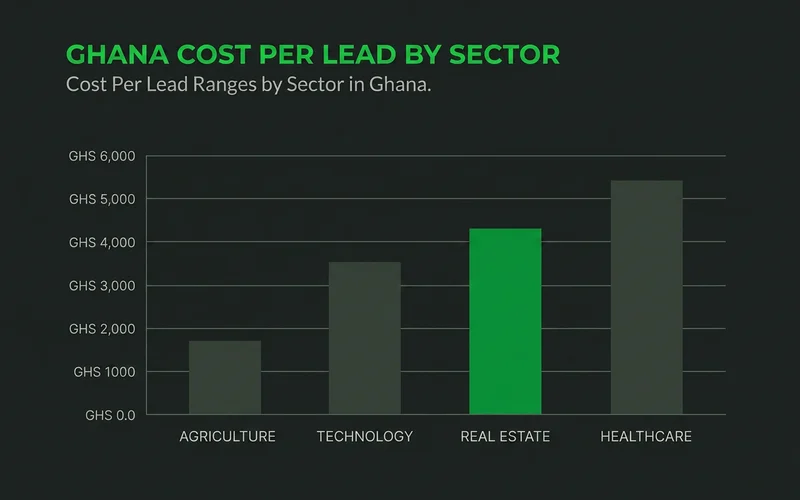
Typical ranges by sector
The average cost for a qualified inquiry varies dramatically based on your industry, audience size, and average ticket value. Industry data across multiple verticals helps identify reliable lead cost by sector performance bands for local businesses running structured campaigns. These figures serve as orientation markers rather than absolute targets.
According to 2026 Google Ads benchmark data, highly competitive sectors like legal and real estate frequently push past $100 per lead globally. Our clients in Ghana experience similar upward pressure in professional B2B services due to smaller, highly targeted audiences. You can expect costs to scale upward as the lifetime value of the customer increases.
| Sector | Relative CPL | Why |
|---|---|---|
| Restaurants, takeaway, retail | Lowest | High volume, low ticket, broad audience |
| Salons, personal services | Low | Local, frequent purchase, visual channels work |
| Hotels and guesthouses | Low to mid | Seasonal, competes with booking platforms |
| Trades and home services | Mid | Genuine intent, moderate competition |
| Dental and general clinics | Mid to high | Trust-sensitive, longer decision, higher value |
| Specialist healthcare | High | Small audience, high customer value |
| Professional and B2B services | Highest | Very small audience, long sales cycle, high value |
Recent RapportAgent research for 2026 shows home services like plumbing and HVAC average around $85 per lead on Google Ads. We consistently observe that smaller target audiences force platforms to work harder. This reduced pool of potential buyers naturally drives up the auction price to reach them.
Why Accra costs more than Kumasi
The cost difference between major cities comes down entirely to advertising density and auction competition. We consistently see Greater Accra generating the highest keyword auction prices in the country. This single geographic variable dictates budget planning more than almost any other factor.
Accra simply houses a larger concentration of businesses actively bidding for the same search terms. Our tracking shows this higher density forces the algorithm to charge more per click to secure top placement. You will routinely pay a noticeably higher price in Accra than in Kumasi for the exact same campaign setup.
Recent 2026 market reports note that digital advertising spend in Ghana is growing by over 6% annually. We know this rapid growth disproportionately impacts the capital city where commercial activity is concentrated. This is a competition effect, meaning a higher price tag does not indicate a better quality prospect.
To adjust your geographic strategy and protect your budget, consider these two proven approaches:
- Allocate funds by city: Regional budgeting prevents national averages from overspending in smaller, less competitive markets.
- Utilize hyper-local SEO: An optimized Google Business Profile captures highly motivated map traffic for free.
Calculating the CPL you can afford
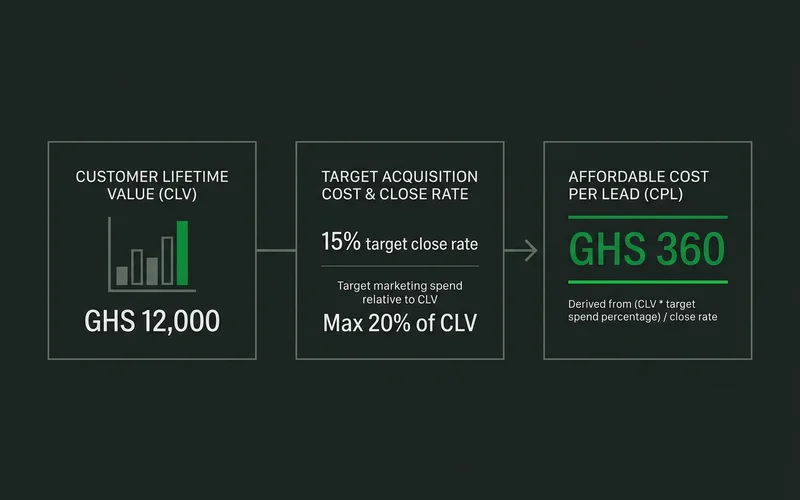
You can determine your maximum affordable cost by working backwards from your average customer lifetime value. We use a three-step formula to keep client expectations grounded in mathematical reality. This calculation prevents businesses from justifying campaigns that quietly drain their bank accounts.
To get started, you must gather three specific metrics from your sales data. Our baseline assessment requires total honesty to produce an accurate target budget:
- Average customer value: Calculate what one new client is worth, including highly predictable repeat business.
- Close rate: Measure the exact percentage of inquiries that actually sign a contract or make a purchase.
- Acceptable acquisition cost: Decide what share of the customer value you are willing to spend to acquire them.
For most local services, allocating between 10% and 25% of the total value is sustainable. The math requires a simple equation: affordable CPL equals customer value multiplied by the acceptable share, then multiplied by the close rate.
A clinic with an $800 average patient value, a 30% close rate, and a 15% acceptable acquisition share can afford roughly $36 per inquiry. We compare this to a takeaway with a $12 average order, a 60% close rate, and a 15% share, which can only afford about $1.08 per contact. This mathematical gap explains exactly why low-ticket food delivery services should avoid buying expensive Google Search clicks.
Your internal sales process also heavily influences that crucial close rate metric. We closely monitor response times because a 2026 MIT Lead Response study highlighted that 78% of customers buy from the first company that responds. You must fix slow communication delays before increasing your monthly advertising spend.
Leads versus qualified leads
A raw lead is anyone who fills out a form, whereas a qualified lead is someone with the actual budget and intent to buy. We see this critical distinction catch business owners off guard constantly. The financial gap between these two categories is exactly where poorly managed campaigns hide their true expense.
Broad targeting parameters create high volumes of cheap, low-friction contacts. Our audits frequently reveal exactly why true costs double when you factor in wasted volume:
- Out of bounds: Inquiries coming from outside your active service area.
- Mismatched intent: Prospects requesting products or services you do not actually offer.
Sales teams lose hours every week chasing down dead-end phone numbers and unqualified messages. Implementing qualifying questions directly into your capture forms is highly recommended to filter out bad fits. A 2025 B2B benchmark report from 6Sense showed that nearly 49% of marketers still incorrectly measure success by counting raw, unqualified contacts rather than verified pipeline.
Optimizing for highly relevant inquiries often requires accepting a more expensive initial click. We gladly make that trade because a smaller list of motivated buyers is infinitely more valuable. Quality always outperforms sheer quantity in a competitive auction environment.
The number to actually watch
Cost per acquisition, not cost per lead. CPL is an intermediate metric. CPA is the one connected to your bank balance.
When your CPL is too high
A high acquisition cost usually stems from poor targeting, slow landing pages, mismatched channel intent, or an unfinished learning phase. We always investigate foundational areas before recommending any budget increases. You should check the underlying mechanics of your campaign rather than arbitrarily throwing more money at the problem:
- Broad targeting: Paying to reach people who have no interest in your service.
- Slow landing pages: DataReportal’s 2026 statistics show Ghana has over 38 million mobile connections, making mobile speed mandatory.
- Wrong platform: Trying to sell urgent-need services using awareness-led social formats.
The internal checklists always prioritize verifying these elements before adjusting bids, and the landing page is where most of the damage happens: our guide on why Ghanaian websites fail to convert paid traffic works through that diagnosis in order. We know from experience that if a campaign is newly launched, the algorithm simply needs time to learn and optimize.
Patience is often the correct action during the first two weeks of a new digital deployment. Working through the financial arithmetic based on your target numbers will provide total clarity. The detailed guide on how much a Ghanaian business should budget for Google Ads explains how to run this calculation from the opposite direction to finalize your cost per lead ghana strategy.