

What “lead generation” actually describes
You know how almost every business owner in Ghana has hit that blue “Boost Post” button on Facebook at least once. It feels like instant marketing, but the results usually fade as quickly as the budget. We see this exact scenario play out constantly across Accra and Kumasi.
The latest Kepios data shows 8.4 million Ghanaians use Facebook actively. This massive audience makes it tempting to just throw money at the platform. That is exactly why grasping the true lead generation meaning matters so much right now.
Understanding what is local lead generation changes how you spend your budget entirely.
A structured campaign requires:
- Defined targeting to reach actual buyers.
- Custom landing pages built for speed.
- Clear tracking systems to measure every cedi spent.
Our Local Lead Generation work exists to replace hopeful guessing with something you can actually evaluate. Let’s look at the specific steps involved, how true ad campaigns differ from simple boosting, and the exact setup required to track your returns.
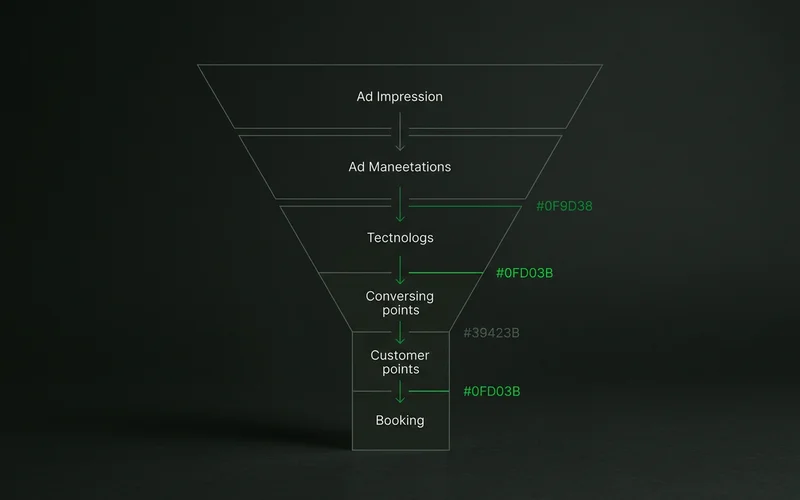
The path from ad to enquiry
Every ad campaign moves through four specific stages. Each phase carries its own unique risk of failure if not managed correctly. We break this journey down to identify exactly where your budget is leaking.
The First Half: Reaching the User
- Impression: Your ad appears to a potential buyer on their screen. This fails when targeting is too broad, causing you to pay for views from people who will never buy. It also fails if the audience is too narrow, which prevents the campaign from gathering enough data to optimize.
- Click: The user taps the ad because they like what they see. This breaks down when the creative promises a specific offer that the landing page fails to mention. You end up paying for a click, but the visitor bounces immediately.
The Second Half: Starting the Conversation
- Enquiry: They initiate contact through a form, a phone call, or a WhatsApp message. This is where most Ghanaian campaigns lose people rapidly. Mid-range phones dominate the local market, and heavy websites load too slowly on basic mobile connections.
- Booking: The initial contact finally turns into a paying customer. Response time dictates success here more than any other factor. Industry data shows that enquiry-to-booking rates plummet if you wait more than an hour to reply.
We rely on tracking each of these steps as distinct events. Claiming the ads failed is rarely accurate. Usually, one specific stage breaks the chain, and fixing it costs far less than increasing your ad budget.
A 2026 report from Yazi highlights that over 90% of connected consumers in Ghana use WhatsApp daily. This makes chat-based enquiries the most reliable conversion method for local businesses.
Why boosted posts are not lead generation
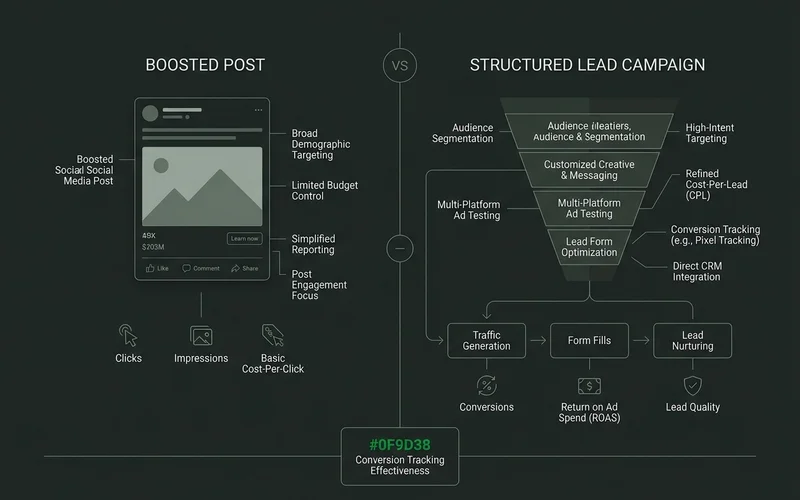
Comparing boosted posts vs ads reveals a massive difference in how platforms spend your money. You pick a post, assign a budget, and hit a button. We constantly remind clients that Facebook optimizes this action purely for engagement.
The system finds users who frequently like, share, or comment on content. These people form a genuinely different group from the buyers actively looking for your specific service. You might receive hundreds of comments from regions hours away, yet generate zero actual sales in your city.
Here is a clear breakdown of how the two approaches differ:
| Feature | Boosted Post | Structured Campaign |
|---|---|---|
| Primary Goal | General engagement | A specific, defined conversion |
| Audience Control | Basic demographic filters | Highly detailed, testable segments |
| Placement Control | Automated by the platform | Full manual control over where ads appear |
| Creative Testing | Limited to one existing post | Multiple image and text variants |
| Performance Reports | Vanity metrics like reach and likes | Cost per enquiry tracked by source |
| Lead Tracking | Missing entirely | Exact attribution to the winning ad |
The top row of this table represents your biggest hidden cost. True lead generation requires intentional design and strict optimization. We build campaigns that tell the algorithm exactly what a valuable customer looks like.
This forces the platform to hunt for actual buyers instead of just collecting virtual applause.
Channel roles: capturing demand versus creating it
Different advertising platforms perform entirely different jobs for your business. Mixing these roles up causes massive budget waste. We structure our approach based on user intent.
Capturing Existing Demand
Google Search targets people who already have a problem and need an immediate solution. A user types “solar installation company in Accra” into their browser. Google Ads meets them exactly at that moment of high intent.
This channel delivers a high conversion rate, though it typically requires a higher cost per click. The total search volume limits your reach, but the quality of the lead remains exceptional.
Creating New Demand
Social platforms like Meta and TikTok reach people who were not actively looking for you. The algorithm places your offer in front of a targeted audience while they scroll. This approach yields a lower cost per click and offers practically unlimited reach.
It works exceptionally well for visual services or offers that people did not realize they needed. You are generating interest from scratch rather than answering a direct query.
The Role of WhatsApp
WhatsApp functions as a conversion destination, not an initial traffic source. Click-to-WhatsApp campaigns run on Meta but push the user directly into a chat window. This matches local behavior perfectly, as Ghanaian buying conversations already happen on this app.
This method usually beats a traditional landing page when you measure the final completion rate. We recommend starting with high-intent channels like Google Search or Click-to-WhatsApp first.
You can add demand creation campaigns later once you prove your core offer actually converts. Running social ads to an untested offer just burns budget quickly.
The tracking rule we do not bend
Nothing launches before conversion tracking is set up and verified with a real test enquiry. An account optimizing towards a conversion action that never fires is worse than one with no tracking at all, because the platform confidently learns the wrong thing.
What tracking actually requires
For effective lead tracking, Ghana business owners must install three specific technical components. None of these elements are optional if you want reliable data. We rely on standard industry tools to connect every click to a specific user action.
- Website Conversion Tracking: You must install tools like the Meta Pixel and Google Tag Manager on your site. These scripts ensure that form submissions and button clicks register as official events. The advertising platform uses this data to optimize future delivery.
- Dedicated Call Reporting: Standard phone numbers blend ad-generated calls into your regular daily volume. You need dedicated tracking numbers or call extensions to isolate the traffic. This proves exactly which campaign made the phone ring.
- WhatsApp Referral Payloads: Chats opened directly from an ad must carry the identity of the campaign that produced them. Implementing the WhatsApp Business API or specific deep links ensures the referral data transfers correctly.
You instantly know the origin of the conversation. We configure these systems to answer the most critical question in marketing. You need to know which specific ad produced which specific paying customer.
Budget allocation stops being an emotional argument once you have this exact data in hand.
What to expect in the first month
The first thirty days of any new campaign require patience and close observation. Your costs will fluctuate wildly during the initial launch phase. We divide this critical first month into three distinct periods of activity.
The Launch and Learning Phases
Days one through seven focus on technical setup and initial deployment. You will start seeing early enquiries arrive as the ads go live. Weeks two and three introduce the algorithm’s active learning phase.
Meta officially states that an ad set requires roughly 50 optimization events within a seven-day window to stabilize. Costs run high during this period while the system aggressively tests different audiences and placements. The platform is buying data to learn what a buyer looks like.
Data-Driven Optimization
Week four brings the first real opportunity for manual adjustments. We execute our first major optimization pass based on actual historical data rather than initial assumptions. The algorithms have gathered enough signal to prioritize efficiency.
Final Steps and Benchmarks
If you want realistic numbers to judge against before you commit a budget, our guide on what a good cost per lead looks like in Ghana sets out benchmarks by sector. It also explains exactly why the market in Accra runs hotter than Kumasi.
Review those benchmarks today to set proper expectations for your next campaign.
Reach out to our team when you are ready to build a tracking system that actually works.