

We often see business owners struggle with the classic debate of seo vs google ads.
You know how quickly a marketing budget can drain when you are paying for every single click. The important distinction most people miss is that one strategy builds a permanent asset, while the other simply rents temporary attention.
Our Local SEO programme and our Google Ads Management service are designed to fix this by running together or separately. Let us look at the 2026 data, what it actually tells us, and explore practical ways to allocate your marketing budget in Ghana.
The real difference: renting versus owning
Google Ads rents immediate attention, whereas local SEO builds a permanent digital asset for your brand. This framing is a strict cash-flow description rather than just marketing language.
We see campaigns produce enquiries from the day they launch, but those leads stop the moment you pause the payment. The relationship between money in and leads out is direct and immediate.
A 2026 Invoca report shows that fully optimized Google Business Profiles convert leads at 43%, beating paid search which sits at 39%. Our team uses this benchmark to help clients understand the long-term value of organic growth.
- The Paid Reality: Ads require continuous funding to maintain lead flow.
- The Organic Reality: Local SEO produces almost nothing for the first two months, then compounds.
- The Ghana Context: In a competitive Greater Accra category, that organic building period is longer.
Speed versus durability
Ads deliver speed, while SEO delivers durability. You can launch an ad campaign and get clicks in hours, but organic rankings protect your business for years.
We often explain that the real deciding factor is what happens when you stop paying. When an ad campaign is paused, enquiries stop that exact day.
A solid SEO programme decays very slowly over weeks or months, meaning you lose momentum rather than your entire position. Our specialists track Time to First Byte (TTFB) on Ghanaian servers, noting that anything over 600ms hurts your organic durability. If the wait is what worries you, our guide on how long local SEO takes to show results in Ghana sets out the month-by-month milestones.
| Feature | Google Ads | Local SEO |
|---|---|---|
| First enquiries | 24 to 48 hours | 3 to 6 months |
| Cost per enquiry over time | Flat or rising | Falls sharply |
| Stops when you stop paying | Immediately | Decays over months |
| Control over targeting | Precise | Indirect |
| Competitive pressure | Raises your cost | Raises the time required |
| Compounds | No | Yes |
The row that decides most arguments is the third one. Ads do not get cheaper just because you have run them for two years.
A 2026 WordStream study found the global average cost per click is $5.42, and that number rarely drops as competition increases. We tell our clients that organic position gets easier to hold once you secure it.
This is exactly why the businesses currently sitting in your Map Pack are so hard to displace.
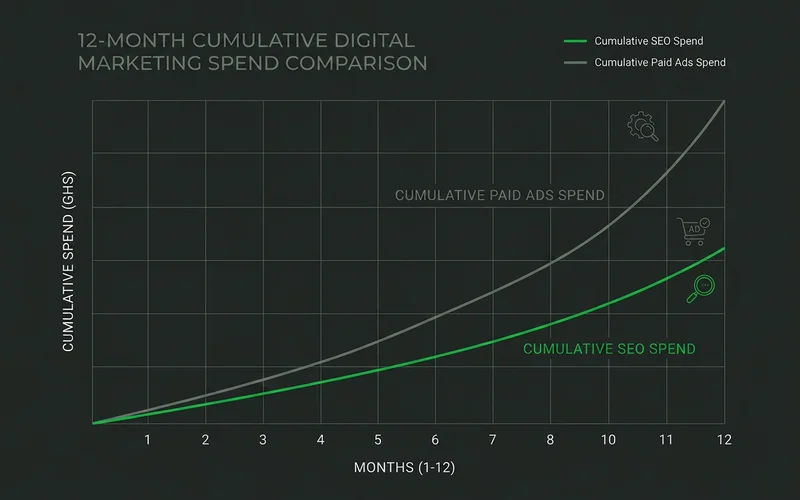
The twelve-month cost curve
The cost curve shows ads winning early, but SEO dominating the long game. Over a twelve-month period, the cumulative cost per lead for organic search drops significantly compared to flat ad pricing.
We can look at a Kumasi service business spending $299 a month on an organic programme, against spending $400 a month in ad spend plus management fees. Months one to three always see the ads winning outright.
The organic strategy is producing very little, while the paid campaign is producing immediate enquiries. Our data shows plenty of businesses mistakenly stop their organic work at exactly this three-month mark.
Where this analysis breaks
If your business cannot survive four months of low enquiry volume, the twelve-month curve is irrelevant. Cash position beats theory. That is the honest case for leading with ads even when SEO is the better long-run investment.
Months four to six are when organic starts landing in the local market. You secure Map Pack positions on some searches, and enquiries arrive without a click cost attached.
By months seven to twelve, the gap widens significantly. We watch the ad campaign cost the same each month, while the organic programme produces more volume for the same flat fee.
This makes your total cost per acquisition drop consistently.
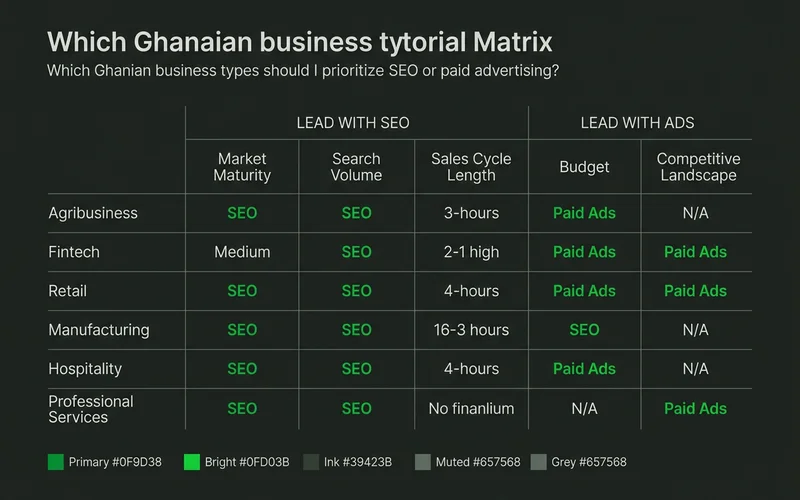
Which Ghanaian business types should lead with which
Established service businesses with good margins should lead with SEO, while new or event-driven businesses should lead with ads. Your specific industry and cash flow dictate which path to take first.
We break this down into three clear categories for the local market.
- Lead with SEO: This is ideal if you have an established Google Business Profile with real reviews. Clinics, established restaurants, and professional services fit here perfectly. You must be able to fund three to six months of building.
- Lead with ads: This works best if you are brand new with no profile history. Event-driven services, seasonal launches, and anything with a high transaction value fit this model. Your margins must comfortably absorb a high cost per acquisition.
- Run both from the start: This is the best option if your budget allows it. The search terms report from your ad account provides the best keyword research available. We use this exact data to show precisely which queries produce actual leads.
Organic credibility directly raises your paid conversion rates. A user who clicks your ad will often check your Google reviews before calling.
Ghana’s e-commerce revenue is projected to grow by 15% in 2026, meaning consumers are researching more before buying. We ensure our clients look completely legitimate across all channels so they do not waste expensive clicks.
When ads are simply the wrong answer
Ads are the wrong choice if your landing page is broken or your pricing math does not support the click cost. Buying traffic will only accelerate your losses in these specific situations.
We see three common scenarios where paid campaigns fail miserably in Ghana.
- The landing experience is broken. A slow, form-heavy mobile page converts badly regardless of traffic quality. Paying for the traffic just makes the financial loss explicit. Fix the page speed first, as it is cheaper than any bid strategy.
- The maths does not work. If your average customer value is $40 and the cost per acquisition in your category is $60, no amount of optimization saves that campaign. You must calculate these numbers before launching.
- Nobody answers the enquiries. Ads that produce WhatsApp messages nobody replies to for six hours are worse than no ads at all. You have literally paid to give the impression that your business is unresponsive.
According to recent industry data, 48% of local searches result in an interaction within 24 hours. If your team cannot handle immediate follow-ups, pause the ads.
Our specialists always audit a client’s lead response process before turning on any paid traffic.
The sequencing question
The best sequence is to fund whichever strategy your cash flow sustains, and systematically build the other underneath it. Treating them as aggressive competitors rather than partners limits your growth.
We mapped this out in our companion guide on where a Ghanaian business should spend first, which works through the same decision as a stage-by-stage tree.
Here are the core principles of a blended approach:
- Assess Cash Flow First: Ensure you can survive the timeline of the channel you choose.
- Fund the Winner: Use the immediate returns of paid ads to finance the slower build of organic rankings.
- Integrate Data: Share keyword insights from your ad campaigns with your organic content team.
Businesses that run both consistently outperform businesses that argue about which is better. A 2026 Clutch survey indicates that 60% of small businesses are actively increasing their digital marketing budgets this year. They are doing this to fund integrated strategies rather than isolated campaigns.
Our firm advises clients to stop viewing this seo vs google ads debate as a rigid choice. Review your current cash flow today and decide which channel can support your immediate goals. If you need help structuring your strategy, reach out to our team to map out your exact timeline.